

DataScaleFail #13
Welcome back to DataScaleFail where we explore the systems, benchmarks, and architectural decisions that actually hold up under pressure.
In this edition, we take a fresh look at Cassandra 5 performance, discuss the development of the PostgreSQL DBaaS market, and share the 2026 extension to our existing, comprehensive review of benchmarking suites.
Cassandra 5: A Reality Check on Performance Claims
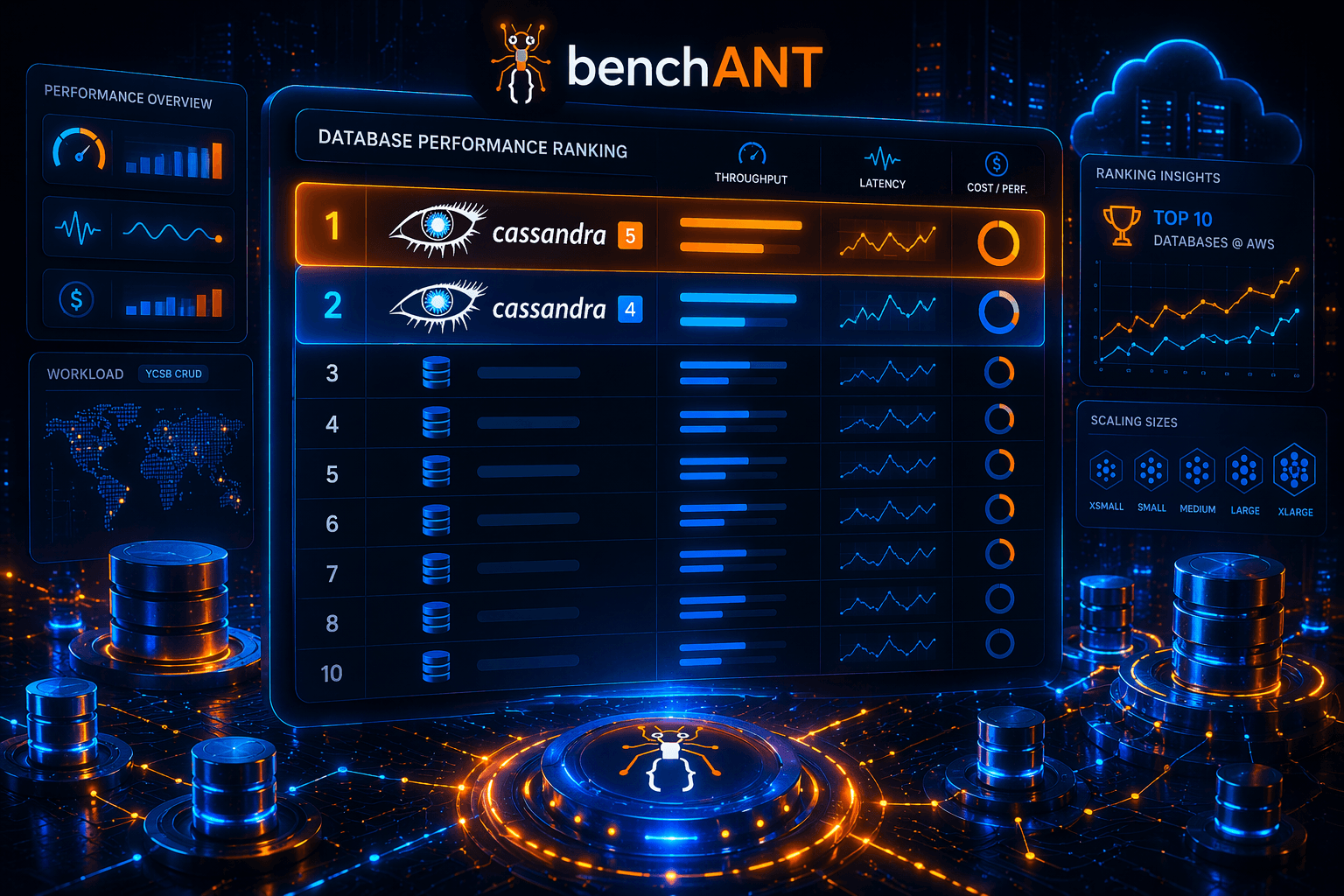
Apache Cassandra 5 represents a significant major release with deep architectural improvements targeting core performance characteristics. This sounds promising on paper, but do these promises keep up with reality? We've benchmarked Cassandra v5 comprehensively across five scaling sizes applying the CRUD workload used in benchANT's database ranking.
Zoom into this article to understand if you should consider upgrading your Cassandra v4 installation and the impact such an update has.
PostgreSQL DBaaS: Benchmark Framework Update

PostgreSQL's dominance continues to expand into the rapidly evolving Database-as-a-Service market. Today's landscape spans hyperscalers, regional Tier 2 providers, and dedicated PostgreSQL-native platforms, each offering distinct performance characteristics and operational capabilities. This fragmentation makes independent, reproducible performance comparisons essential for informed infrastructure decisions.
benchANT has expanded its framework to support over 40 PostgreSQL DBaaS offerings under standardized workloads such as YCSB, OLTP, and OLAP. A large-scale performance study is currently underway comparing different providers. We are seeking input from the community to find out which additional providers to benchmark next.
Benchmarking Suites Update 2026

In 2024, we published a compendium on database benchmarking suites that categorizes established benchmark suites and describes their origin, scope, and methodological characteristics. In the last two years (2025–2026) new benchmarking suites have emerged to address new developments for OLTP, OLAP, HTAP, and time-series workloads.
In this article, we have systematically documented benchmark suites that have become relevant. As in the original article, we cover the origins of each benchmark, its technical scope, workload characteristics, and applicability.
Enjoyed this edition?
Thanks for reading this edition of DataScaleFail. Want more? Check out the previous edition or the archive. Share this newsletter with your team if they are evaluating database technologies or making infrastructure decisions.
We'd love to hear from you:
- Are you running Cassandra 5 in production and have a tuned configuration that outperforms our results? Submit it to us and we'll benchmark it.
- Interested in seeing benchmark results for a specific PostgreSQL DBaaS provider? Vote in our community poll or reach out directly.
- Got questions or a benchmark you’d like us to cover? Get in touch.
Sign up for the next issue of DataScaleFail to stay updated on new benchmarks, database releases, and performance insights that matter for your infrastructure. Until next time, keep questioning your results.