

Same PostgreSQL, More Throughput: AWS RDS M8a Benchmarked
AWS has expanded its database instance portfolio with fifth-generation AMD EPYC processors. On 30 September 2026, they announced M8a instances for Amazon RDS, alongside R8a instances for RDS and Aurora. We tested the general-purpose M8a family with AWS RDS PostgreSQL to see how it compares with the latest Intel and Graviton configurations that haven already been listed in our DBaaS OLTP Ranking for some time.
The result: The new db.m8a.2xlarge delivers approximately 23% more throughput than db.m9g.2xlarge, the previous performance leader in our public DBaaS OLTP Ranking. It also achieves the best price-performance among the published configurations, despite a higher monthly cost.
For readers new to the ranking: we compare managed database services using a common workload and defined resource limits. The PostgreSQL OLTP comparison focuses on short transactions such as order processing and payments. We publish the configurations and raw measurements so readers can examine the comparison and reproduce the workload. Our ranking introduction explains the methodology in more detail.
What changes with M8a?
M8a adds another processor option alongside the Intel-based M7i and Graviton-based M7g, M8g and M9g configurations in the public ranking. According to AWS, each M8a vCPU corresponds to a physical CPU core. This is relevant when comparing instance specifications: equal vCPU counts do not guarantee equal processing capacity across processor families.
For this benchmark, we selected db.m8a.2xlarge, which provides 8 vCPUs and 32 GiB RAM. The CPU and memory allocation comes from the selected instance size, while storage capacity and storage type are configured separately. As with the other tested RDS M-family instances, it uses EBS storage.
RDS offers General Purpose SSD and Provisioned IOPS SSD options. We retained gp2 for this measurement to match the existing AWS baseline. This keeps the comparison focused on the instance choice within the same deployment setup.
Mapping M8a to the SMALL specification
The SMALL specification used in the ranking limits each database instance to 8 vCores and 32 GiB RAM and requires high availability. The new M8a deployment uses the following configuration:
| Setting | Tested configuration |
|---|---|
| Database | PostgreSQL 17.5 |
| Instance | db.m8a.2xlarge: 8 vCPUs and 32 GiB RAM per node |
| Region | Frankfurt, eu-central-1 |
| High availability | Multi-AZ DB instance deployment: one primary and one standby |
| Storage | 500 GiB gp2 SSD per node |
| Database settings | Default PostgreSQL 17 parameter group; no external connection pooler |
In this Multi-AZ deployment, RDS synchronously replicates the primary to a standby node in another Availability Zone. All benchmark requests go to the primary; the standby provides redundancy and does not serve read traffic. This is the same two-node HA setup that was also used for the existing RDS results.
We use BenchBase’s TPC-C workload, which models order processing through a mixture of read and write transactions. We apply a scale factor of 150, corresponding to a dataset containing 150 warehouses, and run the workload with 75 concurrent clients. The workload runs for 30 minutes using SERIALIZABLE as isolation level. BenchBase is deployed on a separate c6i.4xlarge EC2 instance in the same region.
The Throughput metric found in the ranking is the requests per second across the transaction mix as reported by BenchBase. It is worth noting that the numbers are not official, audited TPC-C results and do not use TPC's tpmC metric. The measurement describes performance at this workload and concurrency level, without workload-specific database tuning.
OLTP performance: M8a takes the lead
The published M8a measurement reaches approximately 5,036 ops/s, with a P95 latency of 37.0 ms (P95 is the response time within which 95% of the measured requests finish; lower is better). M8a leads both throughput and P95 latency among the public SMALL OLTP results.
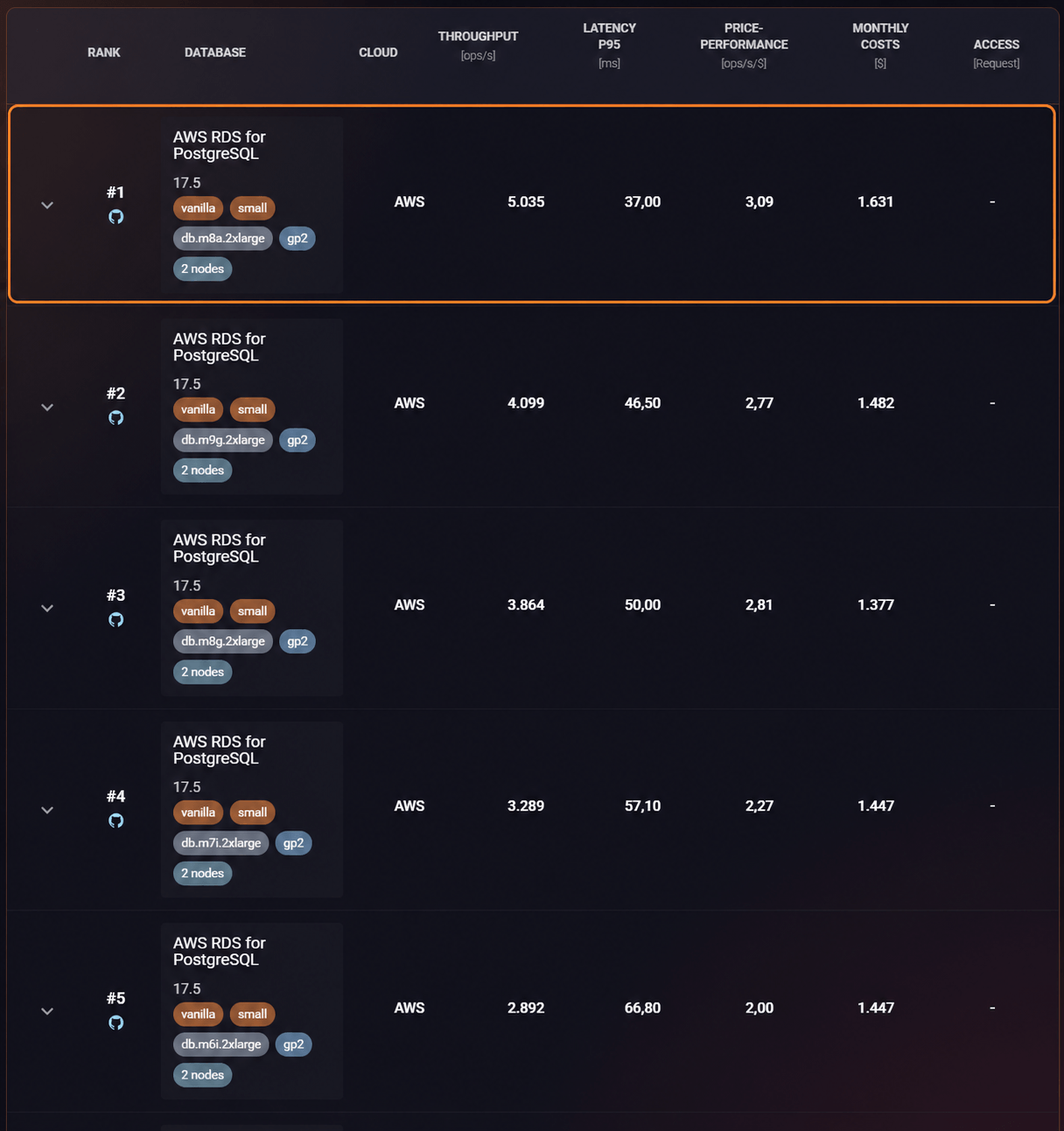
The strongest competitors within our ranking are within AWS RDS, where the tested instances share PostgreSQL 17.5, 8 vCPUs, 32 GiB RAM, 500 GiB gp2 storage and the same HA setup. Compared to M9g, throughput rises from approximately 4,099 to 5,036 ops/s (+23%), while P95 latency falls from 46.5 to 37.0 ms, a reduction of 20%.
Compared with M8g, M8a delivers approximately 30% more throughput; against the Intel-based M7i configuration, the increase is approximately 53%. In the wider public ranking, M8a reaches roughly twice the throughput of the tested Azure configuration and 2.8 times that of Google Cloud SQL N4.
This makes M8a worth testing with an existing application workload. Whether the same advantage appears in production depends on its query mix and concurrency. The comparison measures the complete RDS configuration, including its processor, memory and storage behaviour. Repeated measurements would also help assess variation, since the published dataset contains one M8a run.
Price-performance: the gain exceeds the cost increase
The benchmark configuration records an on-demand monthly cost of $1,631.54 for the M8a deployment. The comparison covers database compute and storage for the HA setup. Backup storage, data transfer, support plans, the benchmark client and application operating costs are outside the ranking’s price-performance calculation.
This is approximately 10% more expensive than M9g, listed at $1,482 per month, but the measured throughput is approximately 23% higher. Dividing throughput by monthly cost gives M8a 3.09 ops/s per monthly dollar in comparison to 2.77 ops/s per monthly dollar for M9g.
M8g previously had the strongest price-performance evaluatoin among the public entries, at 2.81 ops/s per monthly dollar. M8a improves on that by approximately 10%. It therefore leads both performance and price-performance in this comparison, even though it has the highest monthly price among the tested RDS configurations.
For an existing RDS deployment, the practical question is whether the application can use the additional capacity the instance provides. The benchmark ratio helps compare the measured results; it does not imply that switching a lightly loaded database to M8a will reduce its bill.
Future tuning options
This result uses the default PostgreSQL parameter group and the existing gp2 baseline. Further experiments can investigate whether PostgreSQL configuration changes or a different storage setup improve performance sufficiently to justify their additional cost. RDS storage options, including gp3 and Provisioned IOPS, provide additional configurations to test.
Building on these OLTP results, we plan to extend the ranking with analytics and vector search workloads to help readers compare instance choices for different application requirements. Tests at different concurrency levels will add another perspective: how each configuration’s throughput and latency respond to growing application demand.
Summary and outlook
M8a raises the performance of the public PostgreSQL OLTP comparison: approximately 23% more throughput than M9g, lower P95 latency and the highest measured throughput relative to monthly cost. The result shows why instance selection deserves attention even when the database engine, advertised resource size and HA setup remain the same.
Explore the live DBaaS OLTP Ranking and the M8a configuration and raw measurements to examine the result alongside the other published configurations.