

PostgreSQL Extensions for Analytical Workloads
PostgreSQL uses a database architecture optimized for transactional processing. For organizations that require real-time reporting without the complexity of maintaining separate data lakes or dedicated analytical platforms, vanilla PostgreSQL frequently encounters performance bottlenecks for analytical workloads. Complex aggregations and multi-way joins over large datasets require significant disk I/O and CPU cycles when executed against standard storage engines.
At Berlin Buzzwords 2026, our CTO Daniel Seybold highlighted a structural convergence, detailing how the PostgreSQL ecosystem is evolving to bridge the gap between transactional and analytical processing. Instead of treating PostgreSQL purely as an operational data source that feeds external platforms via Change Data Capture (CDC) or Extract, Transform, Load (ETL), developers are adopting extensions that augment the core database engine for analytics instead. These extensions introduce columnar storage formats, vectorized query execution, and hardware acceleration directly into the PostgreSQL process space.
Background
Evaluating these tools requires an understanding of how database workloads interact with specific physical storage layouts and execution models.
Workload Types: OLTP vs OLAP vs HTAP
OLTP (Online Transactional Processing): Optimized for highly concurrent, low-latency writes and lookups. Data models are normalized to minimize redundancy, and the system relies on indexes (e.g., B-trees) to fetch or update specific rows quickly.
OLAP (Online Analytical Processing): Characterized by long-running, read-heavy queries that scan significant portions of a dataset. These workloads rely on denormalized wide tables or star/snowflake schemas to execute heavy aggregations, groupings, and sorting.
HTAP (Hybrid Transactional/Analytical Processing): Involves running both previous execution patterns concurrently against the same primary database engine, requiring mechanisms to isolate analytical resource consumption from transactional throughput.
Storage Orientations: Row-oriented vs. Column-oriented
Standard PostgreSQL utilizes a row-oriented storage layout known as the heap. Data is stored sequentially in 8KB pages, row by row. When a query evaluates a small subset of columns across millions of records—such as calculating a cumulative average—the engine must read entire 8KB blocks into memory, including all unrequested columns. This behavior generates substantial, unnecessary disk I/O.
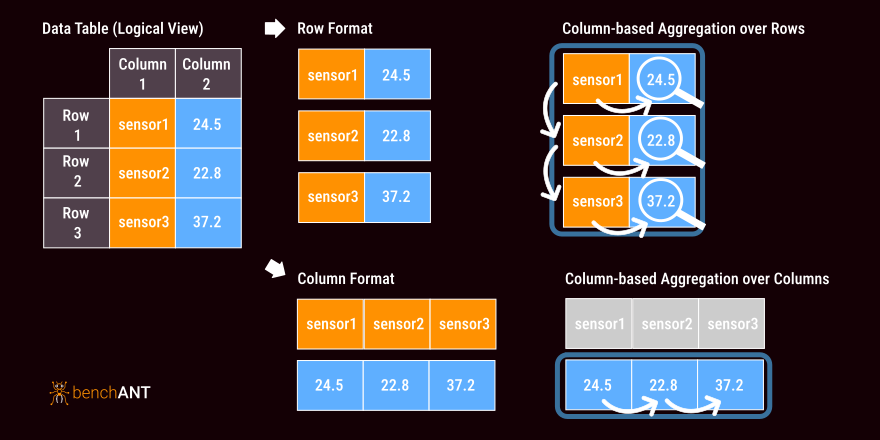
A columnar storage engine restructures the data layout on disk by grouping values vertically by column. This ensures the execution engine only reads the specific columns required by the query payload. Columnar data layouts also optimize data compression because adjacent fields share the same data type, allowing for efficient use of algorithms like dictionary encoding, run-length encoding, or frame-of-reference compression. Furthermore, columnar storage aligns with vectorized query execution, which processes arrays of values in a single CPU cycle rather than utilizing the traditional tuple-at-a-time iteration model.
Overview of Popular PostgreSQL Analytics Extensions
PostgreSQL’s open-source architecture allows external modules to register custom scan providers, index types, and execution paths. Among the more than 1,000 PostgreSQL extensions available, 21 extensions leverage these hooks to optimize analytical processing or to add columnar access. The following list introduces the more prominent extensions.
Citus
Primarily known for its horizontal sharding capabilities, Citus transforms PostgreSQL into a distributed database system by parallelizing queries across multiple worker nodes. To optimize individual nodes for analytical tasks, Citus integrates a columnar storage engine originally derived from the open-source cstore_fdw project. This allows engineers to partition tables and store historical shards in a compressed columnar format on disk, accelerating parallelized scans across the cluster.
pg-strom
The pg-strom extension offloads computationally intensive operations directly to GPUs. It hooks into the PostgreSQL query planner to identify operations like deep table scans, joins, and aggregations that can benefit from massive parallelization. The extension compiles SQL qualifiers into native GPU code (CUDA). To prevent CPU memory bottlenecks, it bypasses traditional OS operations and streams data asynchronously from NVMe storage directly over the PCIe bus to GPU memory. In additional, pg-strom supports Apache Arrow files as a structured columnar format for storage.
TimescaleDB
Designed for time-series data and metrics tracking, TimescaleDB introduces "hypertables," which automatically partition data into time-and-space chunks. Beneath this abstraction, TimescaleDB features a proprietary columnar compression engine. When chunks transition past an active transactional write window, the extension converts the underlying data from standard row-oriented heaps into compressed column segments using specialized encoding algorithms to optimize time-centric analytical queries.
ParadeDB
ParadeDB targets search-focused analytical workloads, serving as an in-database alternative to external search engines. Implemented via specialized extensions like pg_search, it embeds the Tantivy search engine directly into the Postgres process using a Postgres-Rust bridge (pgrx). Among other features such as text search and fuzzy matching, ParadeDB also introduces a columnar storage to enable efficient filtering, sorting, and aggregating for analytical queries.
pg_duckdb (Embedded DuckDB Embedded)
The pg_duckdb extension embeds DuckDB’s columnar, vectorized execution engine directly inside the PostgreSQL process. When a query is executed, the extension can intercept the execution plan and delegate processing to DuckDB. This architecture allows users to query standard Postgres tables with an optimized analytical engine, or use PostgreSQL as an entry point to read external formats like Parquet, Apache Iceberg, or Delta Lake tables stored in object storage (e.g., AWS S3), optionally connecting to cloud platforms like MotherDuck.
Comparison (as of June 2026)
| Citus | pg-strom | TimescaleDB | ParadeDB | pg_duckdb | |
|---|---|---|---|---|---|
| Repository | GitHub | GitHub | GitHub | GitHub | GitHub |
| Primary Maintainer | Citus Data (Microsoft) | KaiGai/HeteroDB | Tiger Data | ParadeDB | DuckDB Labs |
| Latest Stable Release | 14.0 | 6.1 | 2.28 | 0.24.1 | 1.1.1 |
| GitHub Stars | 12.6k | 1.4k | 23k | 9k | 3.1k |
| License | AGPL-3.0 | PostgreSQL License | Apache 2.0 | AGPL-3.0 | MIT |
| Main Language | C | C/CUDA | C | Rust | C++ |
| Key Features for Analytics | Distributed tables and queries, columnar storage | GPU-accelerated query execution, columnar storage | Hypertables with columnar storage | Columnar storage and internally embedded full-text search engine | Internally embedded analytics engine with support for regular Postgres tables and external data lakes |
Managed & Enterprise Architectures
For managed cloud deployments and enterprise systems, vendor-specific variations of PostgreSQL automate these architectural adjustments at the infrastructure layer.
Google AlloyDB
AlloyDB is a cloud-native, PostgreSQL-compatible database from Google that decouples compute from storage. It incorporates an automated, in-memory columnar engine. A background storage agent continuously processes the Write-Ahead Log (WAL) to identify frequently queried tables and columns, dynamically materializing a vectorized columnar representation in memory. This allows transactional operations to write to standard row-oriented storage without performance degradation, while analytical queries automatically route to the optimized memory cache.
EnterpriseDB Postgres Analytics Accelerator
The Postgres Analytics Accelerator (PGAA) from EnterpriseDB is part of their Postgres AI Analytics offering and decouples compute from storage to query large datasets. It uses a vectorized query execution engine capable of offloading resource-intensive operations using Seafowl or Apache Spark (optionally with GPU accelaration). The platform features native lakehouse connectors that allow Postgres to query external object store formats like Parquet, Apache Iceberg, or Delta Lake directly.
Summary
The viability of using PostgreSQL for analytics depends heavily on workload characteristics and data structure. Columnar storage formats and vectorized execution frameworks provide clear efficiency gains for long-running aggregations and scanning wide tables compared to vanilla PostgreSQL.
This still raises the question whether these extensions do act as an all-purpose fix for hybrid workloads. In particular, if their performance is indeed competitive to the performance of specialized OLAP database systems. This will be the topic of an upcoming post in which we will publish a detailed series of empirical performance evaluations. Here, we will highlight throughput and latency profiles of analytical workloads with these extensions and compare them to prominent OLAP database systems.
Because performance gains are sensitive to specific schema layouts, index strategies, and query syntax, determining the optimal database architecture requires objective verification. benchANT specializes in running automated performance benchmarks across diverse DBaaS platforms and distributed database systems. We construct empirical testing pipelines modeled on your production workloads to evaluate your query performance, hardware utilization, and efficiency.